
Types of Sun Control Films Available in Bangalore
Dyed Film
ENTRY LEVELBasic polyester with dye layer. Provides privacy and some glare reduction but minimal heat rejection. Fades to purple over 2–3 years. Common at local garages. Not recommended for Bangalore's heat.
Metalised Film
INTERMEDIATEUses metal particles for heat reflection. Better heat rejection than dyed. However, it interferes with GPS, FASTag, and mobile signals — a major practical issue in Bangalore.
Carbon Film
GOODCarbon particles for heat absorption. No signal interference, matte appearance, good heat rejection, stable colour over time. A significant step up from dyed film. 5+ year lifespan.
Ceramic Film
★ RECOMMENDEDNano-ceramic particles. Highest heat rejection (65–70% TSER), zero signal interference, crystal clarity, 99% UV blocking. Colour-stable for 10+ years. The professional standard.
At Top Secret Detailing Studio, we install Evo Films ceramic-grade solar control films — engineered for high-performance heat rejection with complete signal transparency. This is the film we would put on our own cars.
Legal VLT Rules for Window Tint in Bangalore (2026)
The Supreme Court of India has established clear VLT (Visible Light Transmission) minimums for vehicle window tinting. Non-compliance can result in challans and mandatory film removal. Always insist on legally compliant films from your installer.
| Window Location | Minimum VLT Required | What This Means |
|---|---|---|
| Windshield (front glass) | 70% VLT | Very light tint only — primarily UV and IR blocking, not privacy |
| Front side windows (driver + passenger) | 70% VLT | Very light tint for UV/heat, limited privacy |
| Rear side windows | 50% VLT | Moderate tint with better privacy |
| Rear windshield | 50% VLT | Moderate tint with better privacy |
The good news: modern ceramic films can reject 65–70% of solar heat at 70% VLT — meaning you can achieve excellent heat rejection while staying fully legal. The heat-blocking performance of ceramic films is in the infrared spectrum, not the visible spectrum, which is why they outperform dark dyed films at the same legal VLT.
Beware of local garages that offer to apply very dark films and claim "no one checks." Traffic police in Bangalore do conduct window tint checks, and the fine is not worth the risk — nor is the reduced visibility a safety trade-off anyone should make.
Understanding Sun Film Performance Numbers
| Metric | What It Measures | What to Look For |
|---|---|---|
| VLT (Visible Light Transmission) | % of visible light that passes through | 70%+ front, 50%+ rear (legal minimum) |
| TSER (Total Solar Energy Rejection) | % of total solar energy rejected | 50%+ for significant heat benefit |
| IRR (Infrared Rejection) | % of heat-causing IR rays blocked | 80%+ for premium ceramic films |
| UVR (UV Rejection) | % of UV radiation blocked | 99% is standard for quality films |
A cheap dyed film might have 50% TSER but fade and bubble within 18 months. A quality ceramic film at 65% TSER will perform consistently for 10+ years. Always ask your installer for the film's technical data sheet — a reputable studio will have it.
How We Install Sun Film
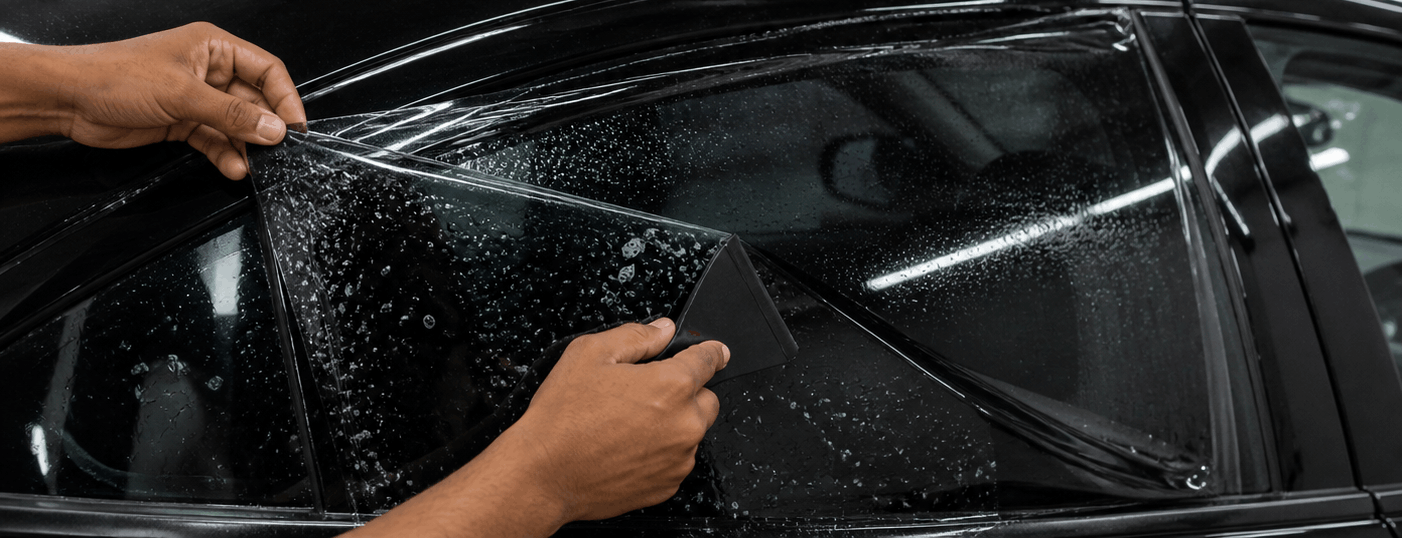
- Glass cleaning: Every window is cleaned inside and out with IPA and microfibre to remove dust, oils, and contaminants. Any existing film is removed completely first.
- Film cutting: Film pieces are cut precisely to each window shape using plotter-cut templates for a perfect fit with no visible gaps or creases.
- Wet application: Film is applied using a slip solution, positioned correctly, and carefully squeegeed to remove all air bubbles and moisture.
- Edge sealing: Edges are trimmed and sealed to prevent lifting, peeling, or dirt ingress along door seals.
- Curing: Windows are left undisturbed for 24–48 hours. During this period, do not roll down windows as the adhesive is still curing. Some haze or small water pockets may be visible — these disappear as the film cures.
Frequently Asked Questions
Book Sun Film Installation in Bangalore
Evo Films Certified · Legal VLT Compliant · 5-Star Rated
Transparent pricing · Located on Magadi Main Road, Bangalore